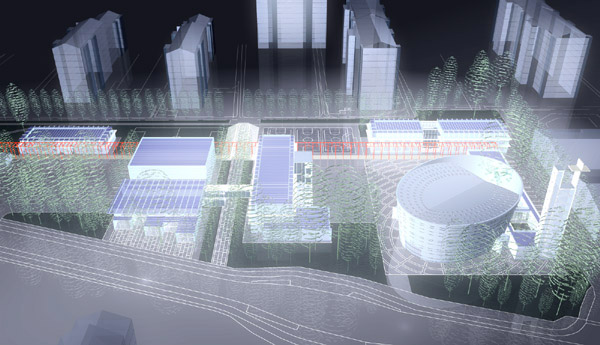
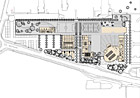
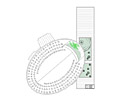
| The design comprises a
multifunctional complex, where religious, educational, residential
and sports programs are connected into a single spatial whole.
The project creates a clearly legible space that guides the
user through a sequence of open environments, squares, paths
and green areas. The complex is not designed as a collection
of individual buildings, but as a connected urban system,
where individual buildings determine the character of public
spaces with their location.
The main spatial core is represented by the entrance square
between the church and the oratory, which acts as a central
meeting point. From here, the main program axis develops,
connecting all parts of the complex and creating a sense of
connection between the eastern and western parts of the area.
The architecture follows the principle of a gradual transition
between public, semi-public and private space, where the boundaries
are not achieved by closing, but are formed by the volumes
of the buildings themselves.
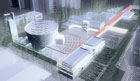
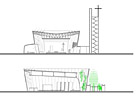
An important emphasis of the project is the volume division.
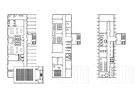
The buildings of the rectory, oratory and kindergarten are
designed as elongated, calm volumes that form the edges of
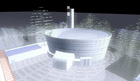
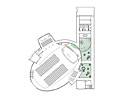
the squares and paths. On the contrary, the church represents
a spatial dominant – an independent and distinct architectural
element that creates a special sacred atmosphere with its
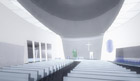
shape and light. The interior of the church is designed as
a unified, almost sculptural space, where natural light becomes
the main architectural element and emphasizes the feeling
of peace and spirituality.
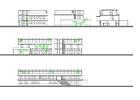
The architectural design of the individual buildings stems
from a common design language. The facades are simple and
calm, with clear geometric features, structured surfaces and
an emphasis on materiality. Greenery, terraces and external
surfaces are not an addition, but an integral part of the
architecture, as they help connect the buildings with the
environment. Special attention is also paid to light, acoustics
and the quality of the interior ambiences.
The sports hall and public programs next to it are positioned
so that the larger volume does not dominate the whole. The
hall opens mainly towards recreational areas, while towards
the street it is complemented by smaller public buildings
that create a more human scale of space. The entire complex
thus unites different users and activities and creates an
open, flexible and sustainably designed environment.
The project won third prize (shared with architect Boris Podrecca)
in an invited competition. First prize was not awarded.
|